

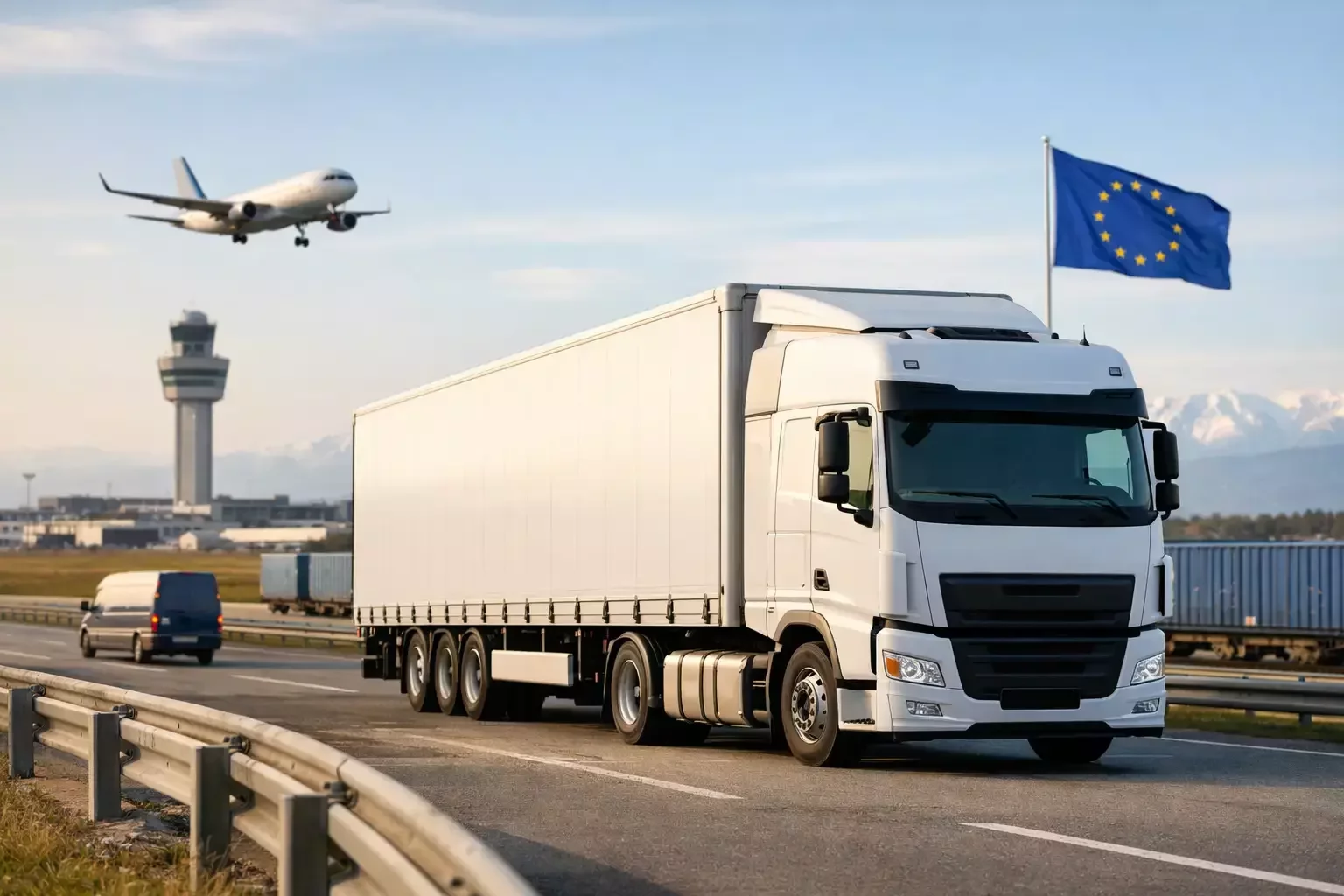
What Is Dedicated European Transport?
If a production line is waiting on components in Germany, or a customer delivery in France cannot slip into tomorrow’s schedule, shared freight networks quickly show their limits. What is dedicated European transport in that context? It is a road freight service where a specific vehicle is allocated to one shipment, or one customer’s load, and moved directly between collection and delivery points with a planned route, controlled timings and minimal handling.
For commercial shippers, that difference is not academic. It changes who has control of the movement, how many times the freight is touched, how much visibility you have in transit and how exposed the shipment is to delays created by hub processing, transhipment or mixed-load priorities.
What Is Dedicated European Transport in Practice?
In practical terms, dedicated European transport means the vehicle is assigned for your job rather than being fed into a hub-based network. The freight is collected, loaded to the agreed vehicle type, and moved on a direct or near-direct route to the consignee. That might be a dedicated van for urgent parts, a dedicated lorry for a full lorry load, or a controlled part-load movement where timing is still managed as a priority service rather than standard groupage.
The key point is vehicle allocation. You are not buying a space on a general network and hoping your freight moves through each stage without disruption. You are buying controlled road transport capacity for a defined shipment.
That matters particularly on UK-European movements, where border procedures, customs documentation, delivery booking requirements and driving time compliance all need to be managed properly. A dedicated model gives the operator more control over routing, timing and communication at each stage.
Why Businesses Choose Dedicated Transport Over Shared Networks
The main reason is simple: fewer variables. In a pallet network or conventional groupage operation, freight usually passes through multiple stages before final delivery. It may be cross-docked, sorted, combined with unrelated consignments and transferred between depots or partners. Each handover introduces another opportunity for delay, damage, misrouting or incomplete updates.
Dedicated transport reduces those handovers. The vehicle stays with the shipment and the route is planned around the job itself, not around a wider network timetable. For manufacturers, distributors and freight forwarders moving commercially sensitive goods, that control is often worth more than a lower line-haul rate.
This is especially true where the load is urgent, high value, fragile, awkwardly packed or time-specific. If a consignment needs to arrive before a booked installation window, support a just-in-time production schedule or avoid unnecessary exposure to handling damage, direct vehicle allocation is usually the safer choice.
How Dedicated European Transport Works Operationally
The process starts with the shipment profile. That includes collection point, delivery point, dimensions, weight, commodity, packaging, Incoterms if relevant, customs status, urgency and any site restrictions. From there, the transport plan is built around the freight rather than around available spare space in a network.
Vehicle selection is the first operational decision. Small vans suit urgent consignments, samples, aircraft parts, medical equipment or other loads where speed and direct delivery are the priority. Dedicated lorries are typically used for full lorry load movements, machinery, packaged goods, production materials or any load that requires sole-use capacity. Some operators also provide express European LTL on selected lanes where the freight does not require a full vehicle but still needs tight timing and active management.
The route is then planned with realistic transit times, legal driving hours, ferry or tunnel options where relevant, and border-readiness built into the movement. On post-Brexit UK-EU traffic, that includes checking whether export and import formalities are in place before the vehicle departs. A direct vehicle is only as effective as the paperwork behind it.
Once in transit, communication should be straightforward. Because the movement is controlled as a dedicated job, status updates are clearer and exceptions can be managed earlier. If a delivery booking changes, a border issue arises or the consignee requests a revised ETA, the operator can respond against a live, dedicated movement rather than trying to influence a larger network flow.
Where Dedicated Transport Fits Best
Dedicated European transport is not for every shipment. If the freight is low value, non-urgent and easy to move through a standard network, groupage may be commercially sensible. The dedicated model becomes more attractive when the cost of delay, damage or uncertainty is higher than the saving made on shared transport.
Typical use cases include line-down parts, production materials, aerospace and automotive components, exhibition freight, retail launches, specialist equipment, contract-critical deliveries and shipments with strict booking windows. It also suits freight forwarders that need a reliable UK and European road partner for shipments where their own customer expects direct control and prompt updates.
Another common fit is commercially sensitive freight. If the shipment should not be repeatedly handled through depots, or if chain of custody matters, a dedicated vehicle gives a cleaner operating model.
Dedicated Vans, Dedicated Lorries and Express LTL
Not every dedicated movement looks the same, and that is where some confusion arises.
A dedicated van is generally used for smaller consignments where urgency overrides unit cost. It offers fast collection, direct transit and reduced handling. For critical spares, engineering parts or short-notice export and import jobs, it is often the quickest road option available.
A dedicated lorry is more suitable where the load needs full vehicle capacity or where the shipment benefits from exclusive use of a larger trailer. That may be because of volume, weight, loading method, security, delivery sequencing or simply because the goods should not be mixed with other traffic.
Express European LTL sits between those two. It is still part-load by nature, but the service is managed around tighter control and selected routes rather than broad pallet-network processing. For some businesses, that provides the right balance between cost and transit discipline.
The Real Advantages and Trade-Offs
The advantages are operationally clear. Dedicated transport gives better shipment control, fewer handling points, more predictable transit, clearer communication and stronger accountability. It can also simplify claims avoidance because the freight is not moving through multiple depots and subcontracted handovers.
However, dedicated transport is not automatically the best option in every scenario. You are paying for allocated vehicle capacity, so the rate is often higher than a shared network movement on a like-for-like weight basis. If your load can tolerate standard lead times and depot handling, a dedicated service may be unnecessary.
There is also a planning point to consider. Dedicated transport works best when the operator has accurate shipment information from the start. Incomplete cargo details, uncertain readiness times or weak customs preparation can still cause delays, even with a direct vehicle in place. The model reduces avoidable transport-side risk, but it cannot compensate for poor shipping discipline upstream.
What to Check Before Booking Dedicated European Transport
Experienced buyers usually assess four things.
First, is the operator genuinely set up for direct UK-European road freight, or simply reselling ad hoc capacity? There is a practical difference between a provider that routinely manages cross-border vehicle movements and one that treats them as exceptions.
Second, how is border coordination handled? For UK-EU traffic, transport planning and customs readiness need to align. A dedicated vehicle waiting at the border because references are missing is not an efficient use of premium capacity.
Third, what level of communication will you receive? A dedicated job should come with proactive status management, not generic milestone updates hours after the event.
Fourth, is the service aligned to commercial freight? Businesses moving production stock, packaged goods, engineering parts or specialist cargo need a transport partner focused on B2B execution, not household removals or general consumer shipping.
This is where specialist operators stand apart. ACS European Transport, for example, is structured around dedicated vans, dedicated lorries and express European LTL for commercial shipments between the UK and mainland Europe, with direct transport control and border-ready coordination at the centre of the service.
Why the Term Matters to Procurement and Logistics Teams
Procurement teams often see transport descriptions that sound similar on paper but operate very differently in practice. Terms such as express, direct, dedicated and priority are sometimes used loosely. If you are tendering freight or comparing providers, it helps to define exactly what you are buying.
Dedicated European transport should mean named vehicle allocation to a defined shipment movement, with direct routing, reduced rehandling and active operational control. If the consignment is still moving through hubs, changing trailers several times or sitting in a shared depot queue, it is not dedicated in the sense most commercial shippers need.
That distinction affects service reliability, claims exposure, production continuity and customer satisfaction. For businesses whose freight has a genuine operational consequence attached to it, dedicated transport is less about speed alone and more about control.
When a shipment is commercially important enough that you need to know where it is, how it is moving and who is responsible for it at every stage, dedicated European transport is usually the right question to ask before you ask the price.
Need Dedicated European Transport?
If your shipment requires direct vehicle allocation, controlled transit times and reliable cross-border coordination, ACS European Transport can help.
We provide dedicated vans, dedicated lorries and express European transport solutions throughout the UK and mainland Europe, supported by proactive communication and border-ready planning.